

Key Skills Required for a Full Stack Developer Role

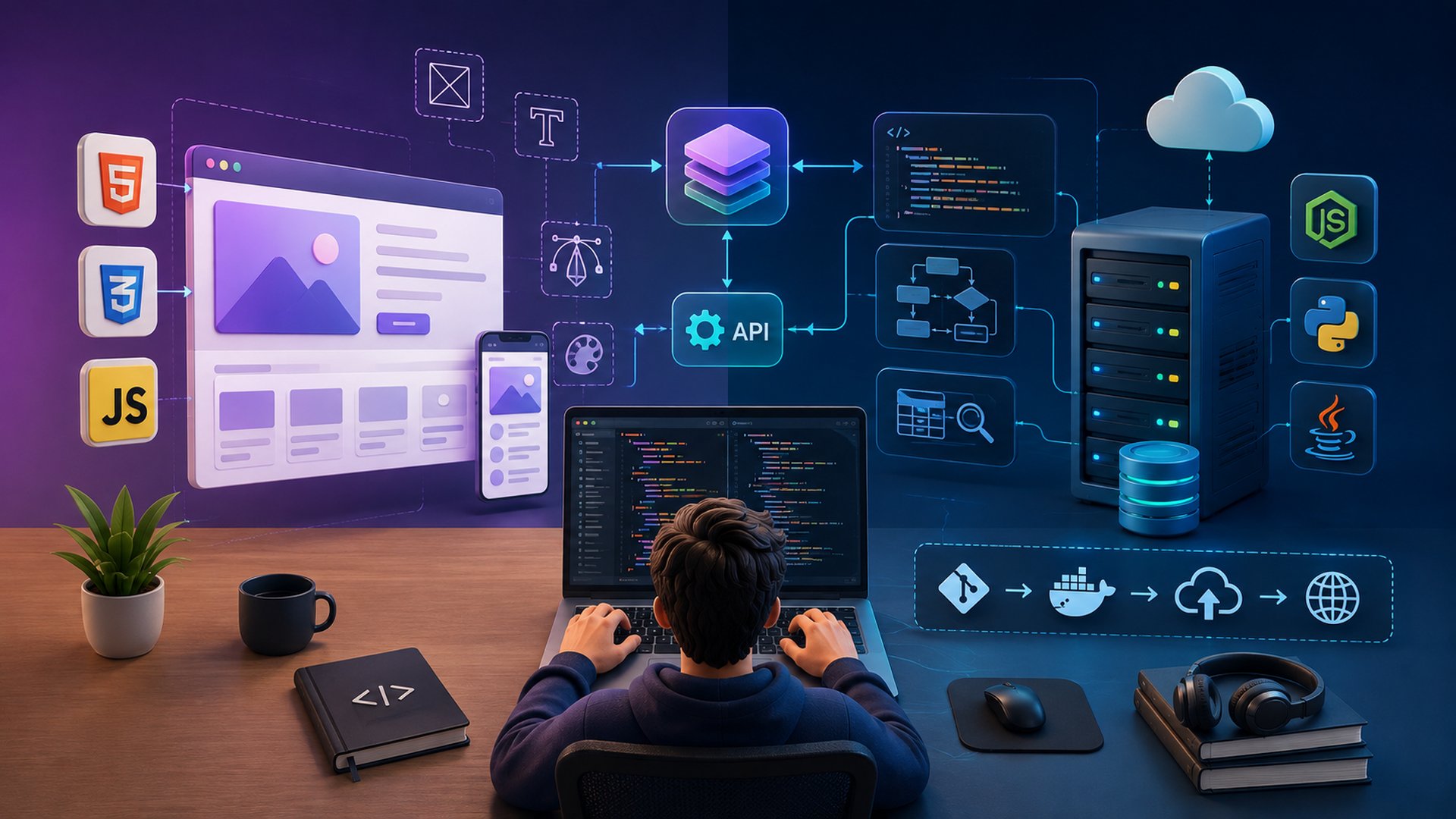
What are the key skills required for a full stack developer role? They span two worlds: the front end users see and the back end that runs behind it. Full stack developers build complete web apps from top to bottom, so the skills required for a full stack developer role touch both sides. This guide breaks those full stack developer skills into plain parts and points you toward a practice-first way to learn them.
What Is a Full Stack Developer?
A full stack developer is a programmer who can build both the front end and the back end of a web application. The front end is what you see and click in the browser. The back end is the server-side code and database that power it behind the scenes.
The word "stack" means the full set of technologies used to build an app. A full stack developer moves between both layers and can ship a working feature end to end.
That range is what makes the role valuable. One person can build a whole product or move quickly between teams. Hyperskill builds its project-based tracks around that idea, so you practice both sides on one real project.
Why Full Stack Skills Are in Demand
Employers value developers who can carry a feature from idea to launch. The pay and the job outlook reflect that value.
According to the Bureau of Labor Statistics, the median annual wage for web developers was $90,930 in May 2024. Employment of web developers and digital designers is projected to grow 7 percent from 2024 to 2034. That works out to about 14,500 openings each year over the decade.
The upper end runs higher. The BLS also reports that the median annual wage for software developers was $133,080 in May 2024. That employment is projected to grow 15 percent from 2024 to 2034.
Full-stack roles tend to sit between these two benchmarks, since the work blends web and software engineering. This table shows where the pay and growth land.
Front-End Skills
The front end is everything a user sees and interacts with in the browser. These skills are the first layer most full stack developers learn.
A few core technologies build the front end:
- HTML: the markup that structures a page's content.
- CSS: the styling language that controls layout and visual design.
- JavaScript: the language that adds interactivity, like menus that open and forms that respond.
- Responsive design: the practice of making a layout work on phones and large screens alike.
- React: a popular JavaScript framework for building complex user interfaces.
You learn these by building. Start with the HTML and CSS basics, then move to the JavaScript Core course to make pages interactive.
JavaScript is worth prioritizing early. The 2025 Stack Overflow Developer Survey of more than 49,000 developers worldwide found JavaScript is the most used language. It is used by 66% of developers, more than any other programming language.
Back-End Skills
The back end is the part of an app users never see. It runs on a server and handles the data and logic behind each feature.
Two ideas sit at the center of back-end work:
- Database: an organized store where an app keeps its data, like users and orders.
- API: a set of rules that lets programs request data and talk to each other.
- Server-side language: the code that processes requests, using a language such as Python or Java.
Most back ends store data in a database you query with SQL. You can build these essential back-end skills through hands-on projects rather than passive reading.
Python is a common back-end choice, and its use keeps climbing. GitHub's Octoverse 2024 report notes that Python becomes the most used language on GitHub, overtaking JavaScript after a 10-year run. JavaScript still ranks first for code pushes alone.
Tools and Practices Every Full Stack Developer Needs
Writing code is only part of the job. Full stack developers also need the tools that move code from a laptop into a live product.
- Version control: Git tracks every change to your code and lets a team work on the same project.
- The command line: Bash and terminal skills let you run tools and manage a server quickly.
- Deployment: Docker and cloud platforms package an app and put it online.
- CI/CD: Automated pipelines test and release new code with fewer mistakes.
Collaboration runs on shared tools. Git and GitHub are the standard way teams track code and work together on the same project.
Deployment matters just as much. Docker and cloud platforms are widely used to package an app and put it online.
Think of these as the glue skills. They prove you can ship a real project and work the way teams actually do.
Soft Skills That Set Full Stack Developers Apart
Full stack work touches many parts of a product, so it asks for more than technical range. A few soft skills matter most.
- Problem-solving: breaking a big feature into small steps you can build and test.
- Communication: explaining trade-offs clearly to teammates and non-technical partners.
- Time management: deciding what to build first when you own both sides of a feature.
- System thinking: seeing how a front-end change ripples into the back end and the data.
These grow through real practice. Code reviews and shipping real features build them faster than any checklist.
How to Become a Full Stack Developer
There is a clear path from zero to job-ready. The order matters more than the speed.
- Learn the front-end basics, starting with HTML and CSS.
- Add a back-end language and learn how databases store and return data.
- Pick up Git and basic deployment so you can put projects online.
- Build real projects and turn them into a portfolio.
Reading about code is the slow path. Hyperskill's model is 80% practice and 20% theory, so you write code from your first day and build a portfolio as you learn.
For a fuller roadmap, read how to become a full-stack engineer. When you have a few projects, build a developer portfolio that proves your skills to employers.
You can also learn both sides with one language through a full-stack JavaScript course.
AI tools help you write and debug code faster, and learning to use them is now part of the job. The languages and frameworks keep shifting, so the habit of steady learning matters more than any single tool.
Frequently Asked Questions
How long does it take to become a full stack developer?
With steady daily practice, many people reach a junior level within a year, though the timeline depends on your hours per week.
Will AI replace full stack developers?
AI speeds up writing and debugging code, but it still needs a developer to design systems and judge which solution to ship.
What is the difference between client-side and server-side?
Client-side code runs in the user's browser and controls what they see. Server-side code runs on a remote machine and handles data and logic.
What are the MERN and MEAN stacks?
Both are JavaScript stacks built on MongoDB, Express, and Node.js. MERN adds React for the front end, and MEAN uses Angular.
Conclusion
The key skills required for a full stack developer role reach across four areas. They cover the front end, the back end, the tools that ship a product, and the soft skills that hold a team together. The fastest way to gain these full stack developer skills is to build real projects and keep practicing.
Start with the Java Full Stack Developer track and write code from your first day.
Discover the key skills required for a full stack developer role, including HTML, CSS, JavaScript, React, Python, Java, SQL, APIs, Git, Docker, cloud deployment, and CI/CD. Learn the essential front-end and back-end development skills, tools, and technologies you need to become a job-ready full stack developer and build a strong developer portfolio.


like this
Create a free account to access the full topic


